Thursday, July 7, 2016

Monday, July 4: The Romans Were Here! (And So Were The Vikings)

This was our last day in York and we set out bright and early.  Here is David in the courtyard of the wonderful apartment where we stayed:

We had a few more items on our list of things we wanted to do before we left York and the first was to visit the "undercroft" of the cathedral.  This was something we'd really been looking forward to; the undercraft is sort of the basement and it has exhibits about the past of the Cathedral.  This includes artifacts related to the current cathedral as well as the older cathedral that was in the same spot before it AND from a Roman building that was there before that.  I had time to visit it briefly during my first visit to York and I remember a Roman mosaic and several other really nice things.   We've heard that there's a lot more there that has been gathered and organized in the years between my visits.

So we arrived eagerly at the cathedral in the morning and saw that there was extra scaffolding around the building that hadn't been there the day before, and a sign saying that the cathedral was closed for the next few days except for services.  They were "striking" the set of the Mystery Plays and I guess that was a pretty big job and they needed to keep the way clear for the workers.  It makes sense, but we were very disappointed.  If we had known earlier it would have been so easy to schedule things differently and to have seen the undercroft another day.

So we were kind of sad and grumpy for a few minutes, but then we remembered we were in York and life was still pretty wonderful and there were still lots of things to do.

First, we went to the Museum of York, which is a great museum full of exhibits about the history of York -- first natural history (fossils, etc), then all the different people who had populated the area from pre-history through Vikings and Romans and on.  After we'd absorbed as much of that as we could, we sat down in the beautiful gardens surrounding the museum and ate our picnic lunch.  The gardens include the ruins of an old abbey and there was a school group there and families with small children running around and it was just lovely to be there.


The gardens also include a very unusual feature: Roman stone coffins.  Apparently when they were digging to create the gardens they found them and just left them as a display.  (The bones inside were re-buried respectfully elsewhere.)

From here we went to our second museum of the day: the Jorvik Viking Museum.  This was more challenging than usual because this museum had to leave its usual home last December when the building was flooded and at the moment its contents are split up into three parts.  One part isn't open to the public yet, but we visited the other two locations.    We learned a lot about the history of the Vikings in York and their way of life.  There were several museum employees dressed in Viking costume and ready to tell visitors about various aspects of the Viking way of life.  All were interesting, but the one that really caught my eye was a young woman doing some kind of needlecraft:

She was creating fabric out of yarn, but it wasn't knitting and it wasn't crocheting and it wasn't weaving.  I asked her about it and she told me it was called naalbinding and it's a old Scandinavian craft that pre-dates knitting by over 1000 years and is still popular in Scandinavia.   It creates a very thick, warm, durable fabric that looks kind of like rows of braids.  She also told me there was a book of instructions in the gift shop -- so of course I snapped one up immediately!  It looks like it will be great fun to learn how to do this, but I need to wait until I get home.  It's going to need some time for concentration and also a type of yarn I don't have with me.

After all this museum walking, David decided to go back to our apartment for a bit of a rest, but I wanted just a little more time to stroll around this beautiful historic city.  Here are two pictures I snapped of interesting old buildings:


And finally, I decided to find a view I'd read about on the web before the trip.  Marks & Spencer has a 4-story location in York and the view of Yorkminster from the top floor was highly recommended.  I found the store and the top floor and discovered that the windows with the good views were all in the tea room.  So I treated myself to a cup of tea and drank in the sight at the same time.

A nice way to say goodbye to this city that I've come to love.

Tomorrow, Edinburgh!

Sunday, July 3: Revisiting Anglican Roots & Drinking Lots of Tea

We started off the day by going to the main Sunday service at Yorkminster Cathedral.  This would have been special any week of the year, but it turned out to be super-special because it was an ordination service and the Archbishop of York was there.  Lots and lots of pomp and circumstance and beautiful music and fancy robes, but also a lot of humor and celebration for the people who were being ordained.  It was a wonderful service and we enjoyed it very much.  The choir was great and the organ was unbelievable. We love our little unassuming church in Kingston, but it's fun to experience the grander side of Christian worship occasionally.

Here's David on our way to church, with Yorkminster over his shoulder:
The apartment we're staying in is over the wall to his left.

The nave (the main part of the church, where the big services take place) has been in an unusual state during our visit because of the York Mystery Plays.  This is a series of short plays depicting the entire narrative of the bible.  They started in medieval times and have been revived during the 20th century.  They were performed in Yorkminster during May and June; we arrived just too late to be able to see them but soon enough to see how the nave was transformed.  They essentially installed a stage on top of the altar and front section of seats, which expanded into raised bleachers for the back section of seats, so that the whole thing looked like a theatre or stadium with tiers of seating.

Not what you'd expect in a church, but we could see that it must have been very effective for the plays.  All this was still in place for the ordination service and while we were at first disappointed not to see things as they normally are we realised that the raised seating gave us a very good view of the service even though we were seated far back.  The service was a beautiful one and extremely well organized.  David and I estimate that there must have been at least 500 people in the congregation and we were guided to the multiple stations for Communion in an extremely organized and stress-free way.  I particularly enjoyed singing some of my favorite hymns in a group that size, led by a very well-trained choir and an incredible organ.

They requested no photography during the service, but I figured it was OK after the service was over and everyone at front had processed out, since they allow photography on the tours.  Here's what the place looked like from our high vantage point:
After the service, the lady sitting next to me pointed in back of us to a huge stained-glass window.  We were seated near the back and so we were kind of high up.  She told us that this window is called the "heart of Yorkshire" because of the heart-shaped section near the top and that it's very unusual to have such a nice close-up view of it.

After church we had "afternoon tea" for lunch:
There are some nutritious sandwiches on the bottom tier under all the sweet stuff!  And of course a big pot of tea in the back, half-hidden by the food.  I'd always wanted to have a traditional British tea and this was a big treat.

After lunch we got on the city of York's tour bus -- one of those things where you can hop on and off to see the sights.  They had a wonderful guide giving live commentary as we went around.  We rode the whole cycle, which took about an hour and I'm not sure he ever stopped to breathe!  He was very informative and interesting and at times funny.  He  was a wealth of knowledge but he wasn't just reciting memorized facts.   He clearly adjusted his speeches according to the occasion.  David and I were sitting near the front and at one point he mentioned that the mother of "the famous General Wolfe" was born at a spot we were passing and nodded and smiled at us.  We were puzzled for a minute -- wondering how we knew we were from Canada -- until we remembered that David had a maple leaf on the bag he was carrying.  (For non-Canadian readers, General James Wolfe defeated the English in the "Battle of the Plains of Abraham" near Quebec City, which basically resulted in Quebec becoming part of Canada and no longer a colony of France.)

In my post about Friday, I very carefully said that we had walked around the whole "old city" and that the old city was surrounded by a wall.  We didn't technically walk the whole wall.  The wall has gaps in it -- parts of the wall that were demolished at various times for various reasons.  At one point on Friday we got to a break in the wall and walked along the streets thinking we were headed for the next bit of wall and we only rejoined the wall much later.  When we got back to our apartment we realized we had missed a section.  Today we decided we wanted to find and walk that section so that we would have really truly walked the entire York wall.  We rode around a little of the bus route again until we found the right place and we completed our walk.

Here's are views of the wall as we approached it from a distance:

and from up close:

This time we arranged things carefully so that David's good arm would be on the side that had something to grab onto in case he slipped and we were both much more comfortable.  In the picture below it may not be clear, but there's about a 6-foot drop down to the grass on David's left:

As we got onto the wall this time I was rather surprised by the following sign:

....until I took a second look and realised that the bridge was being declared free from TOLLS, not TROLLS!  (I used to love the Billy Goats Gruff story when I was a kid, with the trolls under the bridge...)

This is Clifford's Tower, a remaining bit of William the Conquerer's stronghold in York:

This imposing building was for a long time the headquarters of the Rowntree Chocolate Factory:
Chocolate wasn't the first thing to spring to my mind when I thought of York, but we've learned that it was big business here for over a century.  Rowntree developed well-known chocolate items such as Smarties and the Kit Kat and Aero bars.  It was taken over by Nestle in 1988, which continued to use this building for a while but fairly recently moved its operation to somewhere else where labor is cheaper -- a very sort point with the population of York, apparently.  The building is being converted to apartments.  A sweet place to live?

As you climb up onto the wall you see seals like this one:

This "gate" in the wall is called Walmgate Bar and has a special distinction, which we learned about on the bus tour.  It has a section jutting out in front which is called a "barbican".  It's a sort of entry area for people trying to enter the city by that gate, the idea being that if they were enemies the guards could slam down the doors on either side of the barbican and would have them trapped and could shoot them at leisure.  We learned on the tour bus that there are only a few surviving medieval barbican gates in all of Europe and this is one of them.
 
I was lucky enough to shoot a picture of one of the tour buses from inside the barbican:


 The rest of these pictures are views from the wall.  York is a very pretty city!


Sunday, July 3, 2016

Saturday, July 2: A James Herriot Day

David and I are big fans of "All Creatures Great and Small" -- the books as well as the TV series.  Just in case you've never heard of them, they are autobiographical stories by James Herriot, who was a country vet in Yorkshire, and they're beautiful.  He writes with great love of the Yorkshire Dales and I've always wanted to see them.  Even if David and I had been willing to try driving on the "wrong" side of the road way out in the country we wouldn't have known quite where to go to find the kind of places Herriot wrote about.  I went online beforehand thinking I might find a bus tour, but instead I found someone offering private tours in Yorkshire and one of his options was a James Herriot tour.  He had wonderful reviews online so we took a chance and booked a tour and were very, very glad we did.  Alan, our guide, spent the whole day driving us around the Dales and showed us wonderful places and told us great stories.  It was another really wonderful day that we will remember for the rest of our lives.

Our first stop was the James Herriot museum in the village of Thirsk.  (If you have read the books or seen the TV show, Thirsk is the real name for "Darrowby", the village where Harriot lived and practiced.)  Here are David and me outside the museum:
The name "James Herriot" was also a pseudonym; his real name was James Alfred Wight ("Alf" to his friends).  The museum is in the house where he practiced and where he also lived for some of his life.  I was very moved to see his nameplate:
The first book ends on his wedding day, when his boss (the vet who owned the practice) gave him some trivial reason to ask him to stop by the house before leaving on his honeymoon. He got there to discover a new nameplate, revealing his wedding present -- he'd been made a partner in the practice.

Here's a picture of Alf Wight, the real James Herriot from the museum:

and the recreated dining room of "Skeldale House":
and the dispensary:

Thirsk itself is a nice enough little town, but wasn't deemed picturesque enough for the TV series.  We learned that all the exterior shots of "Darrowby" were staged elsewhere, in places we saw later in the day.  But here is Thirsk, the real thing:
Like many of my pictures, this one looks fairly gloomy because it was an overcast day and rained off and on.  We had good luck because it seemed like the rain let up every time we wanted to get out and explore.  I brought along a raincoat but never actually had to put it on :-)

It seemed appropriate to be greeted by a playful cat as we walked down the street after leaving the museum:


And in Thirsk I found something near and dear to my heart: the local knitters had been yarn bombing!
 

Soon after leaving Thirsk, we stopped by for a look at Middleham Castle, the "childhood and favorite home of Richard III".  There wasn't much to see there besides the outer walls.  The castle had been damaged by fighting during Richard III and then (like a whole lot of castles, apparently) torn up a lot more during the Reformation.  Still, pretty cool!

And shortly after that, we passed a pretty spot which was used as a location in a popular movie set in the time of a different King Richard:
Anybody recognise it?

After Alan realised I loved castles, he added a stop at Bolton Castle, where Mary Queen of Scots was once held prisoner:
Another ruin because of Reformation violence, but still really neat to see.

Our next treat was a drive through the high dales.  We went across some ridiculously narrow roads -- the kind where you pray nobody's going to show up and want to pass you! -- through an amazing landscape.  All that grows there is rough grass sort of stuff.  It's bleak but has its own sort of beauty.  Farmers let their sheep loose there, since they like that sort of grass.  They leave them out there all summer and collect them for the cold winter weather -- fattened up without any of the farmers' money spent on sheep food.  Apparently sheep have a strong homing instinct so it's not as hard as we might think to sort out whose sheep is whose.  Many of them also have spots of paint on their backs, which identify their owners.


A notable landmark on the way was the Tan Hill Inn, "Britain's Highest Public House" at 1,732 feet above sea level.  Not very high by Canadian standards, but I can tell you it feels pretty high and remote when you're there.

Back down nearer civilization, we ended our tour by visiting several spots where exterior shots of the TV "Darrowby" were made.  These two places were used in the opening credits:


It was a truly wonderful day.  I first read the Herriot books when I was a teenager, several decades ago, and now I finally can picture what this beautiful part of England looks and feels like.


Saturday, July 2, 2016

Friday, July 1: Falling in Love With York Again


We had a good sleep last night and woke up refreshed and free of jet lag and ready to explore.  I was just a bit nervous because David has been hearing for the last 5 years about how much I loved York and how much I'd love to go back and see more.  When we started planning this trip I wondered if it would hold up to a second visit and whether he'd love it as much as I did.  Well, he does and I have fallen right back in love with York and am so happy to have this second, more relaxed visit here.

The first time I was in York I was here with my Cantabile choir.  We stayed here for several nights, but most days involved day trips somewhere else to sing and we had a limited time to explore York.  We sang an Evensong service at Yorkminster Cathedral and that was a wonderful experience.

Today we decided to start our exploration of York with a visit to Yorkminster.  We with a guided tour.  We had a wonderful guide; I think he must have been both an actor and a history teacher in former lives if not this one :-)  We learned many, many interesting things about the history of the cathedral and how the incredible stained glass windows and other parts of the building were created.  The tour ended just in time for us to whisk ourselves over to a little side chapel where we joined in a small Communion service.

We aren't done with Yorkminster yet; we plan to go back to see the "undercroft" (areas until the main building where they have artifacts from medieval times and even from some Roman buildings that existed at or near the location of the cathedral).  We also would like to hear an Evensong service -- as part of the congregation instead of the choir this time! -- and we'll go to the big morning service on Sunday.  We learned today that this Sunday's service is special because some deacons are being ordained, which means extra pomp and circumstance and that the Archbishop of York will be officiating.  He actually doesn't spend a whole lot of time in York but circulates around the whole area under his charge, so you don't usually see him when you go to a service at the cathedral.

In the afternoon we took a long walk around the boundaries of the "old city", which means York in medieval times.  This old city was surrounded by a wall to keep out intruders from both north and south.  A few bits of the wall were demolished before people started valuing that kind of historical structure, but about 2/3 of it is left.  It's really fun to walk on it and look out over the city.  Much of the wall was built on top of the ruins of an older Roman wall, from the time when this was a Roman city called Eboracum.  The Roman emperor Constantine visited Eboracum as a young man with his father, who was emperor at the time.  His father died during their time in Eboracum and so Constantine was proclaimed emperor here.  There is a statue commemorating that fact near the cathedral.

We spent most of this great day on our feet and had a lot of fun!  I will end with a few of my favorite photos from today.

Exterior shots of Yorkminster:


 A bit of etymology for the day: a "cathedra" is a special fancy chair that only the bishop sits in.  A "cathedral" is a church that contains a "cathedra" -- in other words, it's the official seat of a bishop.  Here is the cathedra of the Archbishop of Canterbury:

The Catholic church uses this term too.  When the Pope says something "ex cathedra" it means he's saying it with the authority of someone who gets to sit on one of those chairs!

The "quire" area of a traditional cathedral is the area nearest the altar.  In the middle ages it was reserved for clery -- including the ones who did the singing (leading to the modern word "choir").  The following picture shows the quire area of Yorkminster, with the organ pipes in the back.  They are beautiful too look at.  We didn't hear them today, but I know from last time that they sound just as great as they look.  We'll hear them on Sunday.

 One of the "gates" of the city wall:

One of the charming old narrow pedestrian streets in York, with another gate showing at the end:

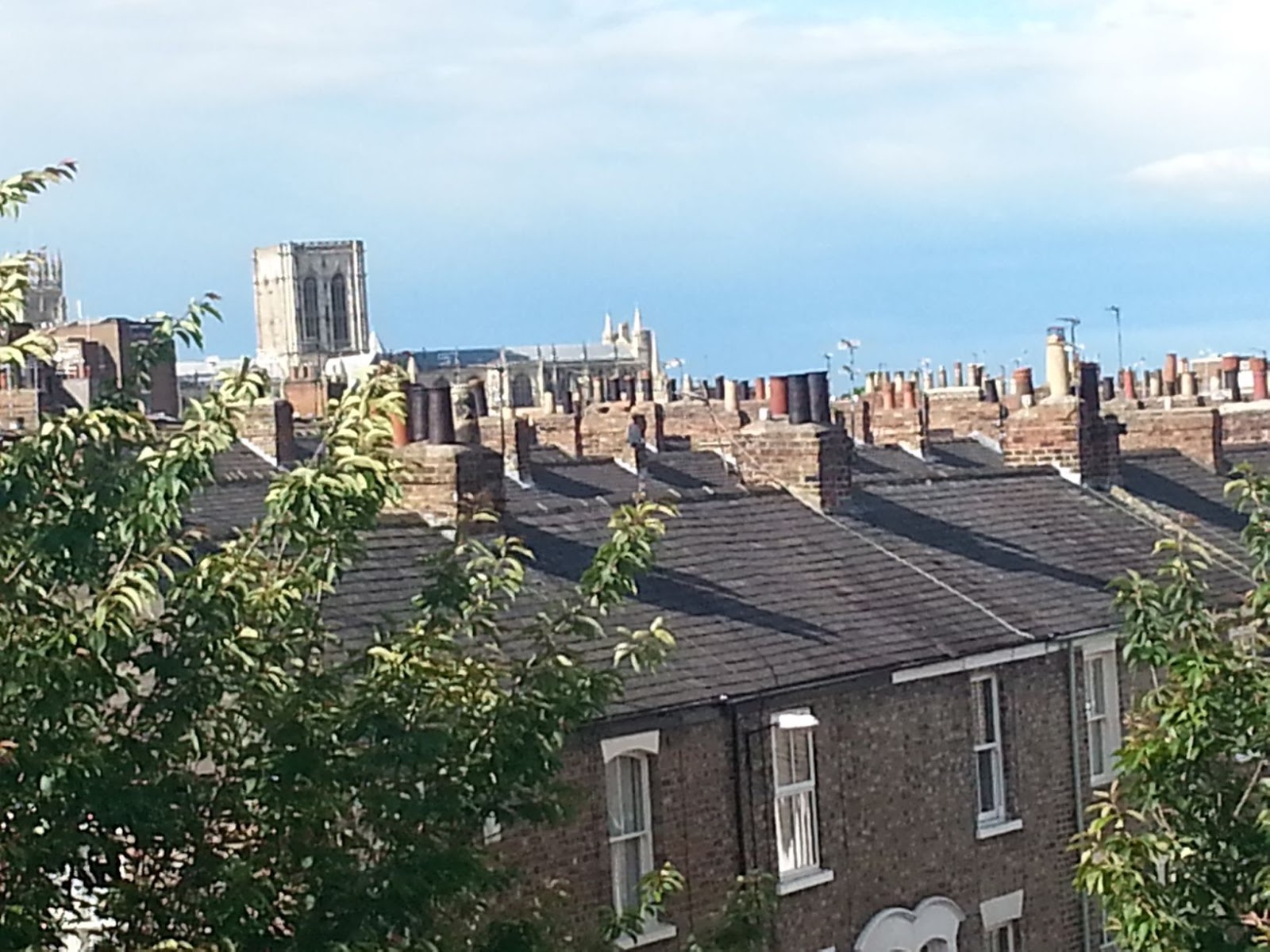
One of my strong memories of York was the amazing number of old-fashioned chimneys on the rooftops in the older neighborhoods.  My choir friends and I used to hum "Chim-Chim-Cheree" as we walked down the streets.

And finally, a happy husband enjoying his walk on the wall:

Well, maybe one more thing.  Confession is supposed to be healthy.  We happened to walk past a yarn stop I visited last time I was in York.  I have lots of yarn just waiting to be knitted up into things.  (In knitting slang, I have a BIG stash!)  I pointed it out to David and said "I don't need to go in".  Well, I could always look int the window.  Well, maybe I'd just pop in for a minute, but I wouldn't buy anything.

What can I say? I'm weak.  It's locally spun and it's part Bluefaced Leicester (a really nice kind of British wool that's very hard to find in North America).  It called to me and said it wanted to be a shawl.  The very nice lady in the shop said "Isn't it pretty?  I've got just the pattern".  What could I do?  Some women buy jewelry; this is my kind of souvenir.  I will have fun knitting it up and every time I wear it I'll think about this trip.